I’m proud to be part of many initiatives in Richland County to promote good mental health. I currently serve as the Chairman of the Richland County Behavioral Health Local Advisory Council. Specific initiatives I’m involved in include:
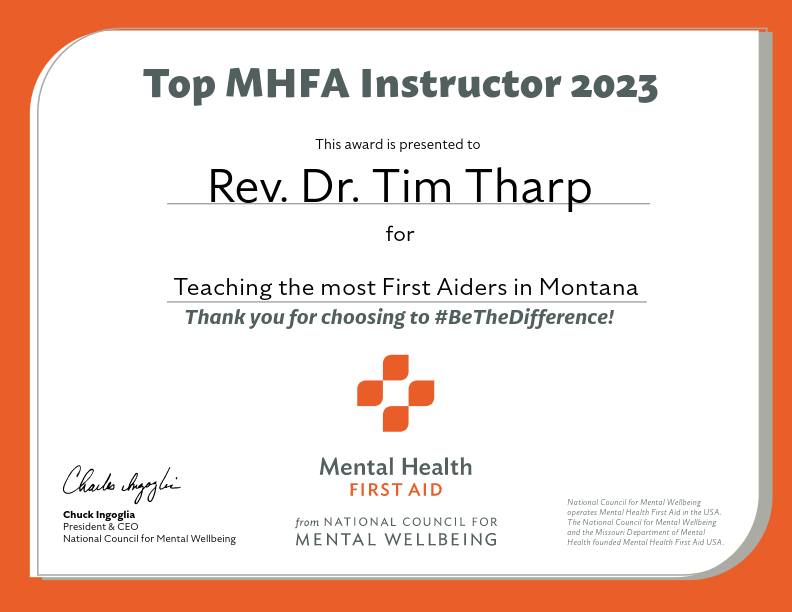
Mental Health First Aid–I am a nationally certified instructor for Youth and Adult MHFA including all of the community specific courses including Indigenous youth, Public Safety Officials, Fire/EMS, Rural, Older Adults, and Higher Education In 2023, I was honored with a certificate for teaching more people MHFA than anyone else in the state of Montana.
QPR–I am a nationally certified instructor for QPR and have taught it to hundreds of people in the region.
Character Strong–This is a K-12 online curriculum and we have secured funding for ALL teachers in Richland County.
Critical Incident Stress Debriefing & Critical Incident Stress Management–I am trained in both CISD and CISM. CISM includes the group and individual debriefing and I am part of the Northeast Montana CISM team.
Wellness Recovery Action Plan–While I am trained as a WRAP instructor, I find that I mostly include WRAP information and knowledge throughout all of the other classes that I teach.
As many people know, I first did research on student achievement in schools that have a four-day week in 2013. I conclusively determined that student achievement drops over time. Here is where my original research lives as well as updates over time.
Paper written after speaking at a national four day school week conference in fall of 2023:
Thoughts from Four Day Week School Week (4DSW) Conference
By: Dr. Timothy W. Tharp
(Elected Richland County Superintendent of Schools, retired school superintendent, principal, and teacher in MT & ND, former Montana Deputy State Superintendent of Public Instruction, former school board trustee, and current Chairman of the Montana Board of Public Education)
When I told people that I was going to be attending and presenting at a national four-day school week conference in Oregon instead of attending MCEL 2023, the most common response I got was “are you speaking for or against?” While my original research that was concluded over a decade ago came to a definitive conclusion on student achievement, the issue is way more complex than just considering student test scores. Furthermore, I believe that we are well beyond the concept of “for” or “against” at this point in Montana as so many schools have already switched to a four-day week. Plus, the research shows that nationwide, hardly anyone ever switches back to five after going to four. So impassioned arguments for or against and discussions about trying it for a while or going back to a five-day week will prove to be a waste of time. The bottom line is that it is here, it is here to stay, and it is likely to grow. What I will attempt to summarize in this writing is what I learned at the conference, what other states are doing, and some suggestions as to where I recommend that we should consider going in Montana.
WHY 4DSW?
Initially done to address issues surrounding long travel distances for students in some of our smallest schools, it has become a very common recruitment and retention tool in today’s labor market. One thing that I learned from this national conference is that the problems we face in Big Sky Country are no different than in the rest of the country. Our pipeline of new teachers is not likely to improve anytime soon and a variety of ‘grow-your-own’ models, training paras to transition to a licensed teacher, and other innovative strategies are being tried all over the US.
One good question that came up was, “if you had unlimited resources to recruit and pay staff, would you have gone to a 4DSW?” The answer for most would likely be a resounding “NO!” The 4DSW was characterized by an economist who attended as the “second-best” option to many who were trying to figure out staffing issues. (The best solution is that imaginary concept of unlimited resources……)
But regardless of what else we are doing to deal with the labor shortage, the issue we face right now is that many schools have gone to a 4DSW to recruit and retain staff. And I realize that it doesn’t make sense to stand your ground and insist that you will never consider 4DSW if everyone around you does it and you can’t hire teacher. Thus the question that we NOW face is, “how do we best DO four-day?”
TAKEAWAYS
One of the key takeaways from the conference for me is that many schools that transitioned from 5DSW to 4DSW across the country reduced their student-contact time. Yes, in Montana, all of the schools are meeting their 1080-hour requirements, but I’m assuming that when you were on a 180-day schedule, you were likely to exceed that 1080 minimum by a higher margin than you are today. The schools in attendance who have been highly successful INSISTED that they would not reduce student instructional contact time, and in some cases, even increased it. I’ve characterized some of the transition to 4DSW as a ‘race to the minimum’ regarding the accreditation requirements for contact hours. There are many schools in Montana that used to have much a lot more contact time that have reduced their hours. They are still meeting the minimum standards but have still reduced their hours of instruction. And there is no way that you can argue that the same amount of quality instruction can occur with 1085 hours of contact time when you used to provide 1150 hours.
The next is the need for professional development for administrators. I would guess that the vast majority of administrators in schools that changed to a 4DSW did not have any professional development in advance of the change. Your focus was likely on how to figure out contracts with staff, how to redo a calendar that had enough minutes (see above), and how to create a daily schedule that maintained the minutes needed yet provided prep time for the teachers. The reality is that for the 4DSW to be successful, it is going to require a mind-set that is different than the way most of us were trained. This goes well beyond the need to put 1.25 days into 1 day and figuring out how many minutes to add to meet the 1080. Focused professional development on how to be an effective leader in a building using the 4DSW is necessary.
And tied right into the above takeaway is the need for professional development for teachers. While we all intuitively seem to understand that we need to have time for rewriting pacing guides, teaching in a 4DSW is quite different than the 5DSW. It is going to take a mental shift in how to teach in a longer day, how to accommodate the inevitable student fatigue, and the other issues that result in the decreased number of days to get through the curriculum. It was suggested at the conference that others have “cut the fluff”, but from a teacher attending the conference, it was pointed out that these are the things that students remember about their education. Cutting that favorite dinosaur unit or eliminating field trips may allow more focus on pounding through the mandatory curriculum, but is that really what we want to see in our classrooms? How we provide professional development on 4DSW for the teachers is difficult given that we as administrators have not had any. PLUS, if we are expected to LEAD this teacher PD on 4DSW, we are all woefully inadequate.
What do you do with day 5? Many who implemented the 4DSW in recent years said that they would use day 5 for increased attention given to students who are struggling. However, this is not something that has actually transpired as many face difficulties in requiring attendance. And something else that was consistent nation-wide was that there have been no increases in teenage pregnancy rates, students committing property crimes, and otherwise causing mayhem in their communities during day 5. When I did my original research, this was a common concern from parents and community. Daycare challenges DO exist, but for the most part, communities have figured out ways to address these.
Another big take-away from administrators at this conference was to clearly establish your non-negotiables before transitioning from 5DSW to 4DSW. What are the hills that you will die on? Student contact hours? Professional development for staff? Consideration of student/community impacts on day 5? When school administrators and district leadership established these ahead of time, they were more successful.
PD for students—After a lifetime of being in education either as a student, teacher, or leader, the shift from 5DSW to 4DSW would be difficult for me. The same shift has to occur for our students, families, and communities. Discussions with students and families on the importance of sleep, staying caught up, reminders that missing a day in a 4DSW means missing more instruction than it used to, and other changes they will have to make is important. We are here for the kids—-so let’s not forget about them when considering preparing for the 4DSW.
Realize that student achievement will be affected. While my research stood alone ten years ago and was treated with skepticism, current research is confirming the conclusions I originally made. And that is that in general, student achievement DROPS when a school transitions from 5DSW to 4DSW. However, this can be mitigated by taking into consideration many of the items I have outlined above. It’s important to realize that not EVERY school than has transitioned has seen this drop because they have implemented many of the strategies I describe. And number one among those—they did not reduce student contact time.
The thoughts expressed above are not a formal position of any association or group with whom Tharp has been or is currently associated. They are simply the observations and suggestions of a career educator who wants to help provide some suggestions, ideas, and guidance based upon his experiences.
This past week, our country witnessed one man being found not guilty of murder because he was defending himself and three others found guilty of murder. Over and over, people have claimed that the system is broken and racist and needs to be torn down. It is my observation that the system worked exactly as it was designed. We are NOT a democracy, we are a constitutional federal republic or a representative republic. We are NOT governed by mob rule or by the voices that yell the loudest or destroy the most property in order to try to make a point.
I find it disgusting that crowds gather outside of a court house to chant and yell and demonstrate in an attempt to influence a jury. This type of intimidation and threatening behavior has no place in modern society.
Thank you to all of the jurors in both cases who did their difficult job of weighing EVIDENCE and evaluating FACTS rather than act like the people screaming in the streets who let their emotions override any common sense.
And shame on all of the media outlets who try to pick and chose winners and losers in an attempt to capitalize on human tragedy.
 Tim Tharp -- just me!